Egg Laying in Pets

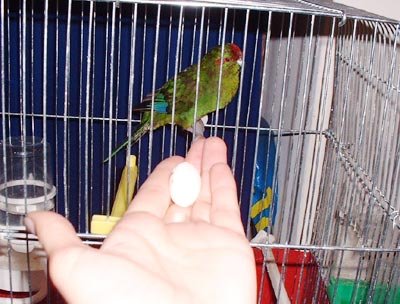
Ah, spring…sunshine, showers, flowers, and egg laying in pet birds.

luca_egg

Not all female pets will lay eggs. My Goffin is 18 and has yet to lay a single egg. Others, often cockatiels, will habitually lay every year. So what do you do?

Remove anything that could be interpreted as a nest site– Happy Huts, boxes, enclosed toys/dishes, tents, etc. Also, do not pet your bird on the back or under the tail, as it simulates a male mounting. Head scratches are fine.

Provide lots of calcium and protein. Excess laying will deplete a hen’s calcium reserves, which can lead to soft shelled eggs (more likely to fracture internally) and brittle bones. Offer cuttlebone and/or mineral block, and cooked scrambled eggs with the shell. If this has been going on a long time, you may need to see a veterinarian for a quicker form of supplementation.

STOP REMOVING EGGS. Birds can count and usually have a specific clutch size that they are trying to reach. Removing eggs means that they never finish their clutch so they just keep laying more. Removing broken eggs is fine.

Once her clutch is complete she may try to incubate the eggs. Incubation lasts three to four weeks for most species. Eventually she should realize that her eggs are duds and abandon them. At this point they can be safely removed. Some hens will lay again, others will not. If she does lay again you can try leaving the eggs in longer. At the very least, leaving eggs in will space out the time in between clutches.

Pad the clutch. Don’t toss out the infertile eggs-save them for next year. If she lays again, add an extra egg in every few days. She should stop laying faster this way. You don’t need to buy fake eggs. Infertile eggs from the previous year work fine.

Decrease daylight hours (note–this does not work on all species). Most species are springtime breeders. Even birds that can lay year-round usually become more hormonal during the spring. You can try to shorten their breeding season by fudging their daylight hours. Covering the cage early at night may help.

Rearrange the cage, or move to a different cage. Disrupting the home environment can sometimes break the cycle.

If all else fails, you have two options: see a vet or give her a box.

If your pet has had issues with calcium depletion or egg binding, definitely see a vet about hormone shots.

If your bird is just determined to lay every year regardless of what you do, give her a nestbox in the spring. The idea is to get her used to laying in the box and only the box. That way when you remove the box, it signals the end of the breeding season for her.

For more information: Discouraging Breeding Behavior in Pet Birds

©2016 by Karen Trinkaus May not be reprinted or used in any way without the author’s permission. Image submitted by reader.

Cockatiel

Nymphicus hollandicus

cockatiel-head-shot-2-1310680-1598x1198

In the Wild
Like budgies, cockatiels also hail from the deserts of Australia and breed very easily when given a constant supply of food. They are also extremely hardy, making them a perfect choice for beginners.

Noise
Tiels love to whistle, or at least the males do. Males are very cute when they’re whistling and showing off. They aren’t great talkers and anything they do say will be more of a whistled version. My male tiel Tootsie used to say “pretty bird” and another bird I knew named Jake could say “Jaker Bakers.” Tootsie actually picked this phrase up from him but would only say it once in a blue moon.

Lifespan
20-30 years

Sexing
Tiels are dimorphic which makes sexing easy. Normal colored males have a yellow head. Hens look just like chicks- they are grey and retain the yellow bars on their wings and tail. Mutations often cannot be sexed visually but can easily be distinguished by behavior. Male cockatiels will sing and show off when presented with a mirror. Hens usually won’t show any interest in it at all. More help sexing various mutations, see Sexing Cockatiels Visually.

nymph-parakeets-741374_1920

Weaknesses
Cockatiels seem prone to giardia, a parasitic infection that causes itchy behavior and plucking. Other than this they are quite hardy.

Night Frights- Occasionally an owner will be woken up by the sound of their pet frantically thrashing about the cage. Odd noises, movement or lights may set off such a fright (like if you try to sneak past the bird’s cage at night without turning on the lights). Some frights have no apparent cause. Frights can be dangerous because the bird flaps about, refusing to calm down. Thrashing birds can easily break a wing, leg or bloodfeather. Use flour to clot the blood if a feather is bleeding.

If your tiel is prone to frights there are several things you can do. First, try to find out the cause and eliminate it. Is the bird next to a window? Could passing car headlights be the cause? Try covering the cage or leaving it uncovered. Try placing a night light in the room. If nothing seems to help, it would be beneficial to have a separate cage for the bird to sleep in, one without lots of toys and perches for it to knock into.

One thing you should consider for your own health is that cockatiels are very powdery birds. I wouldn’t recommend them to anyone who has asthma or another respiratory condition. If you still want a tiel but have allergies/asthma, invest in a good air filter.

Husbandry
Cockatiels aren’t as active as kaks or budgies so they don’t require as much room. Still, the cage should always be as large as possible. Pets will require a lot of time out with their owners. Pairs will breed in modest-sized cages.

Breeding
See Breeding Cockatiels.

Diet
Regular psittacine diet. Veggies and leafy greens are favorites.

linus2

Personality/Behavior
The cockatiel personality can be summed up in one word: sweet. The cool thing about cockatiels is you get a bird with all the good qualities of a cockatoo or larger parrot without all the vices. Cockatiels are very cuddly, but don’t get so attached to their owner that they develop bad habits like cockatoos.

A tiel’s favorite place to be is on its owner’s shoulder. Like most birds, they love spending time with the family and will call out if separated. Tiels have a very specific call for “Where did you go? Come back!” and will use it when you walk out of the room. Some owners find this call very irritating, and there are a few things you can do to prevent the bird from calling incessantly. First, keep the bird’s main cage in the living room or other actively-visited room. Second, keep the cage well-stocked with toys so that the bird has something to do when you leave. Third, put the bird on a schedule. Like most of us, birds like knowing what to expect. If you come home every day at around the same time, let the bird out, then put it away while you make dinner, the bird will learn that there are certain times it will be out and certain times it will be caged while people are still around. Multiple birds can also help keep each other company while you are otherwise engaged.

Aside from calling and the typical attitude that comes with puberty, cockatiels don’t have many behavior problems.

© 1997-2011 by Karen Trinkaus May not be reprinted or used in any way without the author’s permission.

Should I buy a Second Bird?

The last time I was at a bird club meeting the speaker was the editor of Bird Talk magazine. She brought up some of the frequently asked questions they receive. As bird club members, we all kind of chuckled at these because they were common knowledge to us. One of the questions they routinely get is “Should I buy a second bird?” She said the fact that the person was even asking the question indicated that the answer was “no.” Most people nodded in agreement at this statement. I beg to differ.

I receive this question a lot too, but most people don’t ask it out of some nagging doubt it won’t work or they shouldn’t do it. In many cases, they want another bird, but are unsure how their first will react. Will the two get along? Will their first bird lose its pet qualities? How soon can they be introduced? What species would be most compatible? To me their question shows that they know enough about birds not to jump into something blindly. They want to educate themselves first. Most people obtain their first bird without doing any research. They learn through trial and error, not really the best way for the pet or the owner, but if they’re trying to rectify the situation the second time around I can’t fault them. There’s nothing wrong with making an informed decision.

rainbow-lorikeet-638413_1920

Benefits of Keeping a Flock

I have a personal philosophy regarding this issue – I never keep birds singly. A bird that has its own cage is still kept near others and allowed play time with them. The only time I completely isolate a bird is if it must be kept in a hospital cage due to health problems. This does not mean that I think every owner should run out and buy more birds. Many people are happy with just a single pet. This article is for those of you who are contemplating buying another bird, but haven’t quite made up your mind yet.

I believe it is psychologically beneficial for birds to be kept in a flock. My adopted mitred conure responded extremely well when kept around my flock. He no longer tries to assault other birds. Many people don’t properly socialize their birds. One of my requirements of socialization is that bird know how to be a bird. A handfed reared in isolation with no avian contact may have identity problems later, particularly if its owner expects it to act like a little human. Birds are not humans and never will be. We both share many behaviors but have different motivations. Understanding your bird’s behavior is the key to getting along with it. I think new owners tend to attribute human motivations to their bird’s behavior or simply treat them as if they have no emotions at all. Both views will lead to problems.

When you allow birds to interact with one another you give them a chance to communicate in their own language and to be themselves. As an aside: One of my pet peeves is when people ask me about teaching their birds to talk or want to know if my birds talk. Yes they talk- they speak bird! You’ll get along much better with your animals if you learn to communicate with them. I’ll have you know I’m fluent in “duck” and “chicken.” I’ve made friends with wild ducks using this skill. Don’t ask me how to teach your birds to talk, ask me how you can learn to speak “bird.”

Not everyone can give their bird the attention it requires. Many people will buy their pet a mirror, thinking this will help keep it company. This is worse than keeping a bird isolated. If you can’t give your bird the attention it needs, give it up or buy a second.

I also believe that owners learn more about bird behavior when observing more than one interacting. Owners of one bird only see that single bird’s behavior. They have no point of reference and mistakenly judge their behavior as “odd.” When you see birds interact with one another it makes more sense.

I also cannot overstate how beneficial it is for birds to have another bird, even a different species, around during the day when you’re not home. Parrots are not meant to be kept in isolation.

Will my first bird lose its pet qualities?

No. If your bird is tame and lovable it should stay that way. I have never seen a bird become unfriendly just because it had a new friend. I think this myth has been propagated by owners whose birds hit puberty the same time as a new bird is purchased. Behavior changes associated with puberty have nothing to do with the introduction of a new bird.

DSCN4087

This guy was handfed and socialized by me. He’s an aviary bird and I haven’t handled him on a regular basis for ten years. Still tame.

Let’s say you buy a new cockatiel. You have it for a few months. It’s so sweet and wonderful you just have to get another one. Your first bird is probably around six months to a year old when you decide to introduce another. Guess what time puberty hits? That’s right, around 6-12 months. The new bird is unjustly blamed for problems that would have occurred anyway.

What species are the most compatible?

This is more of a concern if they are to be sharing a cage. Given a large enough cage, you can probably keep any birds of similar size together. I keep conures, budgies, kakarikis, tiels and ringnecks together, but then I have walk-in aviaries. Territorial issues are less of a problem when you are not breeding.

If the cage is smaller you’ll need the species to be more alike. Tiels and budgies have similar care requirements but they don’t get along well in confined spaces, especially if there are only one of each (or one tiel and numerous budgies). Tiels are mellow birds; budgies are pesky and very active. The constant movement alone can drive a tiel nuts in a small cage. Even if it doesn’t, the budgies are likely to harass the tiel endlessly.

When species are very different (in size or behavior) you need to give each their own cage. I would not keep any of the medium or large parrots together in a standard pet cage. You’d need a large flight to do that.

Supervised play is fine with most similar-sized birds, as long as you know how to read body language and prevent problems.

How soon can they be introduced?

Quarantine all new birds for at least 30 days. By quarantine I mean keep them in another room with NO contact with your current birds. You don’t want to risk bringing in any diseases. Feed the new bird last and change clothes/wash hands before handling your other birds again. I also recommend a vet check and bloodwork if you can afford it. You can see a veterinarian for disease testing or submit it yourself.

amazon&conure

How do I introduce them?

Some species can be thrown in together with few problems. Budgies and tiels usually fall into this category. Heck, budgies typically welcome new birds! However, birds that have established territory- especially perceived breeding territory- may have a problem with a new bird suddenly sharing it. In this case it is best to start out with separate cages, in view of each other, and supervised play time outside of the cages. How soon the two get along will vary. If you see any fighting take things back a step.

How do I keep them from breeding?

Don’t buy the same species or the opposite sex, and don’t give them a nestbox.

© 1997-2002 by Karen Trinkaus and may not be reprinted or used in any way without the author’s permission.
Cockatiel Growth Guide


This slideshow requires JavaScript.

Day 1
Chick doesn’t do much. It can’t hold it’s head up. Not a very strong feeding response. Down moist.

Day 2
Has figured out where the food comes from. Stronger response. Can sit and hold head up fairly well. Down dry and fluffy.

Day 3
Eyes may just begin to open.

Day 4
Eyes opening.

Day 5
Eyes opening.

Day 6
Feather tracts should be getting more apparent. Chick begins to do defense display (hissing and swaying) when woken up or when the container is moved.

Day 7
Band baby. Feather tracts beginning to bud with tiny pinfeathers

Week 2 (Days 8 – 14)
Pinfeathers grow in. Chicks get better balance, start stretching, standing up and flapping their wings.

Week 3 (Days 15 – 21)
Pinfeathers open, tail and primaries (flight feathers) first. Chicks flap their wings and preen a lot. They also begin picking at things around them (you may want to start providing food items to play with now).

Week 4 (Days 22 – 28)
Weaning is well on its way. Chicks will begin flying all over the place. It’s usually good to wait until they have fairly good control at flying before clipping the wings.

© 1997-2016 by Karen Trinkaus. May not be reprinted or used in any way without the author’s permission.