Introducing New Foods

flock

You’ve read up on what you should feed your bird to keep it healthy. Unfortunately, you and your bird seem to differ on what is healthy. New foods are either ignored or flung aside for the good old seed. Here are a few methods for getting your bird to try new foods.

The “Good Stuff” Dish
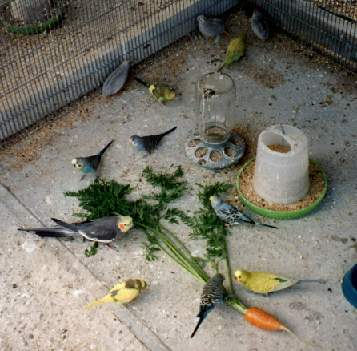
This is the best method for getting a seed junkie to try wet foods. First you have to find a non-seed food that your bird already likes. There is always something. Usually even picky birds can’t resist wheat bread or a frozen veggie mix. With small species you can try greens like parsley or carrot tops. Once you find a food other than seed that it will eat offer it the same time every day, in the same area of the cage, in the same dish. The goal is to make the bird associate that dish with something tasty.

After a week or two start offering something else into the dish every other day. You can mix it together with the old food or just offer the new food by itself. Keep this up and pretty soon the bird should eat any item placed in that dish.

Pellets
Several pellet manufacturers recommend mixing pellets in with seed and slowly increasing the proportion. I’ve found this method counterproductive, as many birds think the pellets are inedible and will throw them aside. Instead, offer the pellets in a completely different dish. Birds are more likely to try this new “toy” than something invading their seed bowl. Roudybush also has several other methods of introduction.

Tutoring
Ever notice how pets always want what you’re eating? Birds follow the examples of their peers. If you have one bird that eats pellets you can usually get your others to do the same by letting them watch. Borrow a friend’s bird to help teach yours if you have to. You can also try pretending to eat the pellets.

Looks Like Seed
Some brands of pellets, like Kaytee Exact cockatiel size, look a lot like seed. Other foods that have a seed-like consistency may be tried more readily, like wheat bread, cereal and sprouted seed. When trying to get your bird onto a different diet any food variety is important no matter how small. If you can get them to try one new thing you can gradually get them to try other things as well.

© 1997-2016 by Karen Trinkaus. May not be reprinted or used in any way without the author’s permission.

Mitred Conure: Fry

fry01

“Butthead”

I was at the vet getting a button quail treated. Dr. Levoy walked in and told me he had a lady in the lobby looking to get rid of a conure. After my appointment was over I found her in the lobby. She was a younger woman, late twenties or early thirties, and was carrying a newborn baby. She explained that she had a mitred conure she was trying to find a home for. It had been in her care for six years. The fact that she’d just had a baby and her husband hated the bird’s noise had forced her to get rid of it. Right now the bird was staying at her parent’s house. Apparently the bird took many such “vacations” to appease the husband. I gave her my phone number and she said she’d call as soon as the bird was back at her house. After a few weeks and no call, I virtually forgot about the incident.

About six weeks after the chance meeting, I got a message on my answering machine regarding the conure. Was I still interested, and if so would I call back and arrange a time to see it? I called her back and agreed to come view the bird.

The bird’s first owner was a woman who’d caught him outdoors. Apparently he’d been dive-bombing some gardeners. He stayed with her a year and then was given to her friend, the woman I’d met. She in turn had had him for six years. The conure was also open-banded, probably with a quarantine band. Considering the history, it was at least eight years old if not more.

I wasn’t expecting much when I arrived at her home. I kept envisioning a bird in a small, dirty cage, with poor plumage and a fierce bite. Imagine my surprise to find a very healthy-looking bird. It was bright-eyed and alert and had excellent plumage. I scanned the cage. It was much too small, but at least it was clean. On top was a T stand, bathing dish, mirror and a single wooden toy. Inside the cage the conure eyed me warily. The woman let him out. I didn’t approach him but instead asked a ton of questions regarding his background.

His owner actually knew quite a bit more than most do. She knew she had a mitred conure. She’d read up on the proper diet but had been unable to convert him. The bird had become so picky that it would eat nothing but safflower seed, white bread and apples (no skin). She said he liked to hang out on the T stand by the mirror but would also climb down the cage and wander around the floor. Among her reasons for getting rid of him was her fear that he would hurt the new baby. He also wouldn’t be receiving as much attention. And of course there was the husband, who’d nicknamed the conure “Butthead.” After spending a good hour probing with my questions, I decided to take him. The bird came free with cage, T stand, mirror, toy, bowl and seed. Had it not appeared so healthy I would not have taken it.

Fry

On the ride home my new bird was rather nervous, but let one good shriek loose. Damn, he was loud.

I renamed the bird Fry. My influence for the name came from two sources: the movie Pitch Black and TV show Futurama. Both have characters by that name, the latter in which the character is a redhead. Aside from these sources, I’d never even heard of that name. “Fry” just had a certain ring to it that appealed to me.

The first thing I learned about Fry was that he didn’t like hands. Aside from that he was fairly tame. If you offered him a finger he’d scramble to get away; if you offered him your arm he’d hop right on. Despite being the largest bird I’ve ever owned, he’s also a strong flier (or jumper) when clipped. I placed his cage on top of my dresser which, unfortunately, had a built-in mirror. The cage was still too small, but it was all I had at this point.

fry03

Changing Diets

Jay-Jay also shared my room with Fry and helped me break his finicky eating habits. If I can get a bird that ate nothing but apple, white bread and safflower seed for six years to eat whatever I offer, YOU can get your birds on a healthy diet. Fry’s owner had tried to get him on a better diet, but he refused to eat anything but the above listed items. I got him eating anything in two weeks.

Jay-Jay’s cage was across the room from Fry’s. Every day I cooked up a meal for the two of them after I got off work. Both dishes were the same style but varying colors. Jay-Jay always dove right for the food. Fry wasn’t stupid. He knew that whatever Jay-Jay was eating in her bowl was most likely the exact same thing in his bowl. It not only seemed edible, but delicious. Jay-Jay could hardly contain herself when she saw the bowls coming. The second day after offering food in this manner, Fry started picking at whatever was in the dish. I mostly fed Crazy Corn, birdie bread and veggies. Every few days or so I’d offer apples too.

In addition to using Jay-Jay as a model, I also used myself. Some time in the afternoon I’d make myself a meal, usually fried eggs and toast or slices fruit, and bring the birds into the kitchen to share it. Fry was nervous around me and the new room so I started out by placing him on the back of a chair across the table while Jay-Jay and I ate. After a few days Fry would jump onto the table and cautiously sneak some food before scurrying back. The toast tempted him more than anything. Jay-Jay always went for the egg yolk.

fry04

Fry cautiously “stealing” some oranges.

A quick aside on sharing foods:
Give birds their own food to eat. Do not allow them to eat anything your mouth has touched. Mammal bacteria can be dangerous for birds and human mouths in particular are bacterial cesspools. Likewise, try not to eat anything they’ve picked at or stepped on. Though it is unlikely you will catch anything, you still don’t know where those birdie feet and mouths have been. How many times have you seen your bird chewing its own dried feces at the bottom of the cage? Always practice proper hygiene with animals.

The Mirror

Fry had a mirror for six years. When I first adopted him I continued to allow him access to it on top of his cage, but draped a towel over my dresser mirror. What more harm could it do?

When he was out of the cage he spent of time just sitting in front of the mirror. He never touched a toy, but took great delight in flying across the room to torment Jay-Jay. He would barge into the cage to eat her seed while she hid inside her Happy Hut.

Fry was downright hostile towards most birds. Jay-Jay seemed to be an exception, maybe because she was larger and a conure as well. Once I had to hospitalize a breeder tiel in the same room. I left for literally a few seconds to fill the water dish when I heard shrieking. I ran back to my room. Fry had flown across the room to the tiel’s cage, pulled its leg through the wire and was in the process of shredding it. The poor bird was already ill and now had to deal with this trauma. I believe it died that night. Embarrassed and ashamed, I brought the poor thing in for a necropsy, making sure the vet knew the leg had been injured post-illness. The results revealed that the cockatiel had been ill due to gout, something I couldn’t have done anything about. I still felt awful about the incident though.

After that I took Fry’s mirror away. He quickly chewed a hole in the towel covering my dresser through the cage bars. A huge hole. Now he didn’t even want to come out of the cage that often, except to harass Jay-Jay. Eventually I re-covered the mirror with a new towel and moved the cage an inch forward, hoping this time it would be out of reach. It was. Fry began to play with his toys. He also started perching on the back of my chair when Jay-Jay and I were at the computer.

fry05

Epilogue

Fry lived with me for several years in an upgraded cage with lots of toys. He eventually died from leukemia.

© 1997-2016 by Karen Trinkaus. May not be reprinted or used in any way without the author’s permission.
Choosing a Cage

I get a lot of questions regarding what cage sizes are “adequate” for specific birds. The simple answer to this question has always been “Get the largest one you can afford.” However, picking out the right cage to meet your birds’ needs can be more complicated than that, especially if you are introducing more than one bird or mixing species. There are several things you should take into consideration when choosing a cage.

Height vs. Width
Birds fly side to side, not up and down. When I first started out breeding budgies I had a cage that was about 18″ wide and long and about 4′ high. It might as well have been 24″ high because that’s the extent of it that my budgies used. Birds need space, but not height. Width is much more important. Had the cage been 18″ wide and tall and 4′ long my budgies would have used the entire thing. Stick to rectangular cages that are longer/wider than they are tall.

Bird Size
How big are your birds? A macaw will need a much larger cage than a budgie. Many of the resources I’ve read tell you that the cage should be large enough for the bird to extend its wings without touching the bars, and large enough to turn around in without smacking the side. This is too small. For a hospital cage this would be fine because you are trying to restrict movement; however a day-to-day cage that the bird lives in should be double or triple this size. It should be able to hold two perches spaced greatly apart as well as toys.

Another funny thing about most parrots is that the smaller they are, the more space they need proportionally. Budgies require a huge amount of space when compared to a macaw (not quite to scale, but see below). This is due to their activity level. I cringe every time I see budgies kept in those tiny, blue, house-shaped cages that aren’t even one foot in ANY dimension. This is like a human being forced to live in their shower stall or closet!

Finches, budgies and smaller species typically require a ton of space when compared to a larger species. However, this doesn’t mean you should short-change your larger pets!

Activity Level
One budgie requires 2-3 times as much space as a cockatiel. Why? Because budgies are more active! This is why smaller birds need more space- generally they are much more active than the larger birds. You can see the difference just by picking them up: budgies and most parakeets “jump” onto your finger (or your shoulder, or your head…); parrots usually “step up,” rather than hop to you. Know your species: kakarikis, lovebirds and budgies are all extremely active. Nonpsittacine species like finches, toucans, mousebirds and other “softbills” are all very active. These birds require a huge amount of space no matter what their size- toucans require an aviary, macaws don’t.

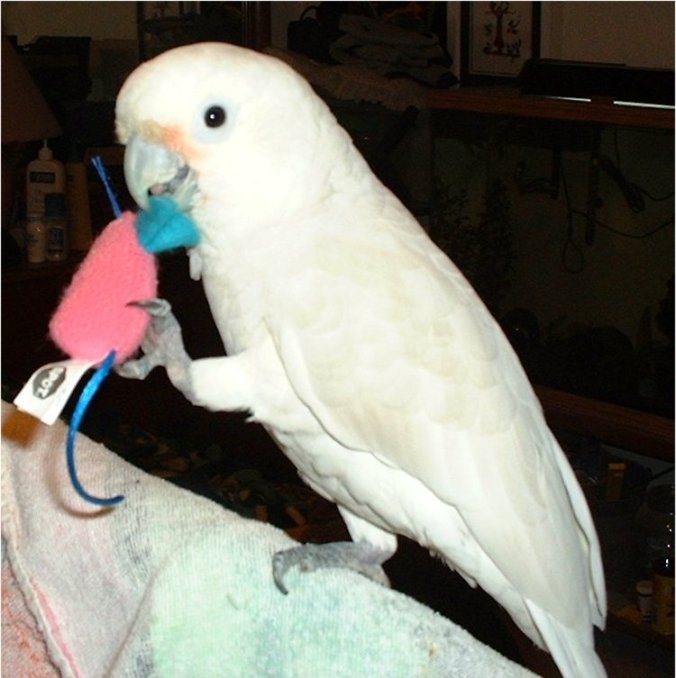
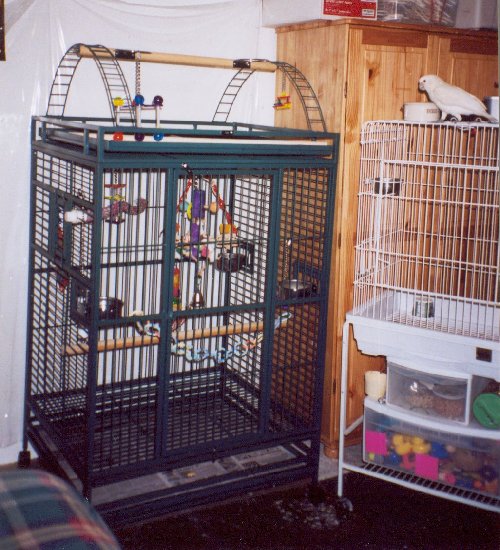
This is not to say that all larger parrots are inactive and don’t require much space. It is important to keep in mind the activity level of the individual bird as well. When my mitred conure Fry died, I bought a Goffin cockatoo, Loki. Fry’s cage was brand new, and huge step up from the original cage he came in. Fry was a fairly inactive bird, so it suited him just fine. Loki, who is relatively the same size as Fry was, found this cage abysmally small. Loki is an extremely active bird, and also easily bored, which means that many toys are required to keep her interest. Fry’s cage was barely large enough for three of Loki’s toys, let alone Loki herself. I began searching for a new cage, and ended up getting macaw/large cockatoo cage. The new cage currently contains 12 toys (two more on the playstand above), and there is still room for her to hop about.

lokinewcage

Loki’s new cage (left) vs her old cage (right).

How much time will the bird spend in the cage?
If you work away from home and your bird is locked up all day, then the cage needs to be very large. Like Loki’s cage, it should have plenty of room for toys, and also plenty of room for the bird to hop about. Fry’s cage [barely] had room for either one or the other. It’s easy to overestimate the size of an unfurnished cage. If you’re at a store, try placing a few toys inside to get a better feel for how much room you actually have to work with. If the bird won’t be able to move around much with three toys hanging inside, then the cage is too small. For a bird that is home all day, the cage should be able to fit at least 2-3 perches (one can be a swing), 4-6 toys, food dishes and the bird itself (with room to jump from perch to perch).

Playstands
If the bird is out of its cage for a good portion of the day, then the cage can be smaller. A birdie-safe “play area” will give your bird a change of scenery and allow it to interact more with you. If a bird is out all day (for those lucky people who work at home) the cage can be much smaller because your bird will only be using it at night. Playstands should make up for the lack of cage size and contain plenty of toys, perches and other goodies to keep your bird occupied.

Mutiple Birds and Mixing Species
More birds means more space. Bickering is normal but if certain birds are picked on more than others or if they are fighting over food/water/perches then the cage is probably too small. When mixing species you must take into account what each is like. Nonaggressive species like budgies and tiels can mix but only if the tiels have room to get away from the budgies, whose constant activity will drive them nuts. See my article on Colony Breeding for more tips.

Shapes
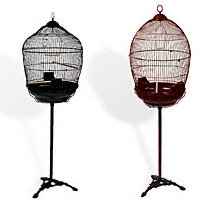
No round cages! No cute house-shaped cages! Cages should be designed for birds, not humans. Odd angles trap toes, create unused space and make cleaning and accessing the cage a nightmare. Stick to squares and rectangles.

Bar Spacing and Alignment
Most small species are fine with 1/2 spacing. Larger birds can have wider spacing, just not so wide that they can get their heads caught. Larger birds will also require thicker wire to keep them from chewing through. There should be plenty of horizontal bars. Clipped birds especially require these to help them get around the cage.

barspacing

If your bird can do this, your bar spacing is too wide.

Finish
Many cages are galvanized. This is fine, but the process of galvanizing can leave traces of zinc and other metals on the wire which can kill your bird. Rinse all galvanized cages with a mixture of vinegar-water to remove these trace metals.

Bottom Grate
This feature keeps your birds from picking at dropped food and feces, as well as the substrate (you can use colored newspaper again!). I highly recommend getting a cage with this.

Acrylic Cages
These cages have their own distinct pros and cons. They are designed for optimal visibility and reduced mess. However, they contain no horizontal bars (although some now add a wire “climbing wall”), have reduced ventilation and climate control, and are extremely expensive.

Below are examples of actual cages offered for sale. I’ll start with some bad examples and then give you a few good designs.

cagecrappy1

Coast Cages Sunburst for Parakeets, Canaries & Finches

What’s Wrong

  • Very poor shape design. How is a bird going to utilize that space?
  • This cage is too small to fit any species. It would only be passable as a carrier.
cagecrappy2

Petco Delux Kit for Canary & Finch

“This deluxe starter kit begins with a stylish, quality cage…”

What’s Wrong:

  • Overall poor design and shape. What does “stylish” have to do with birds?
  • Too small for any bird, let alone an active finch.
  • Beware of “starter kits”- they are overpriced and may contain junk you don’t need (and not enough of what you do need).
cagecrappy4

Avian Select Parakeet Cages

What’s Wrong:

  • Round design- perfect for pinching toes.
  • Generally anything on a stand like this is going to be designed for humans and not for birds.
  • Too small, yet again.

Okay, enough of the crappy cages. Here are some good ones.

cage2

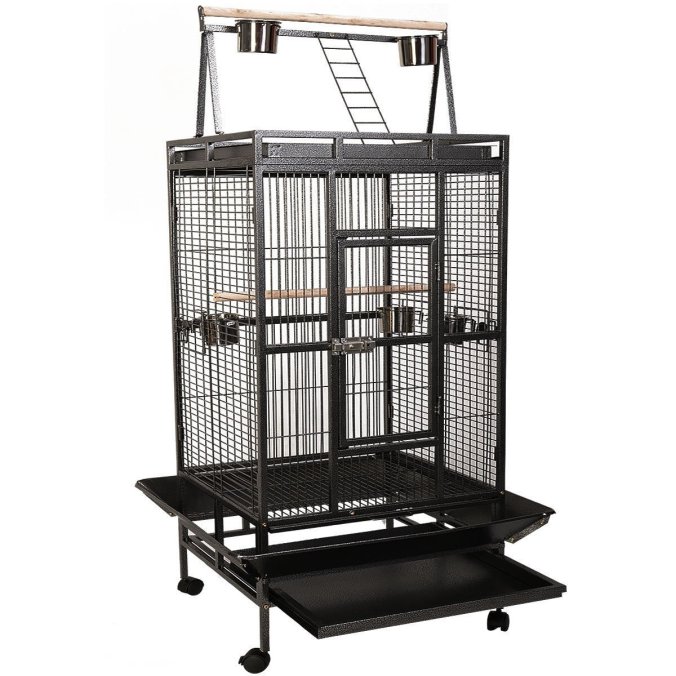
Giantex Bird Cage Large

What’s Right:

  • Rectangular design.
  • Adequate size for small/medium parrots
  • Generic playstand included
  • Bottom grate included
  • Metal seed catcher to reduce mess
  • On wheels to ease movement
  • Large, easy-access door and heavy-duty feeding crocks


71AJvmyEkFL._SL1500_

Mcage Large Wrought Iron Flight Cage

What’s Right:

  • Large
  • Good bar spacing for small species
  • Plenty of horizontal bars
  • On wheels for easy transport and comes apart

© 1997-2016 by Karen Trinkaus. May not be reprinted or used in any way without the author’s permission.

Which Bird is Right for You?

Not sure what bird is right for you? Check these genus profiles. If a ? is noted it means I don’t have enough experience with the species to say.

tiel03_wfcinpearl_cin

Genus/Common Name Nymphicus
Includes Cockatiels
Size Small.
Talking Ability Limited. Good whistler.
Lifespan 20-25
Noise Quiet, but their contact call may be annoying.
Dimorphic Yes. See my Guide to Sexing Tiels Visually.
Comments See species profile for more information. The cockatiel is a good beginner bird that enjoys being pet more than a budgie.

parrots-in-love-1351846-640x480

Genus/Common Name Lories
Includes Lories and lorikeets.
Size Tiny to medium.
Talking Ability ?
Lifespan ?
Noise Varies.
Dimorphic No.
Comments Very colorful and playful. Specialized diet (expensive and causes squirts).

loki17 Goffin cockatoo

Genus/Common Name Cockatoos
Includes Cockatoos
Size Medium to large.
Talking Ability Varies.
Lifespan 50-80
Noise Quiet to loud. Large species are typically very loud. My Goffin is very quiet.
Dimorphic No.
Comments Very demanding pets, but playful and highly intelligent. They are the cuddliest birds you can find. Difficult to breed. Males known for killing, maiming, and trapping hens during breeding.

male-eclectus-parrot-1350890-639x852

Genus/Common Name Eclectus
Includes Eclectus
Size Medium.
Talking Ability Varies.
Lifespan ?
Noise ?
Dimorphic Very. Males are green and females are red.
Comments Matriarcal. Stunning colors and odd feather texture.


scarletchested04

A female scarletchested parakeet.

Genus/Common Name Aussie Keets
Includes Polytelis (suberb, regent, princess), king, Platycerus (rosellas), Psephotus (red-rump, mulga), Neophema (bourke, scarlet-chest, turquoise).
Size Small to medium.
Talking Ability Varies.
Lifespan 10-30
Noise Pleasant.
Dimorphic Some species are.
Comments Good aviary birds but not commonly kept as pets. Rosellas are curious as pets and love to whistle.

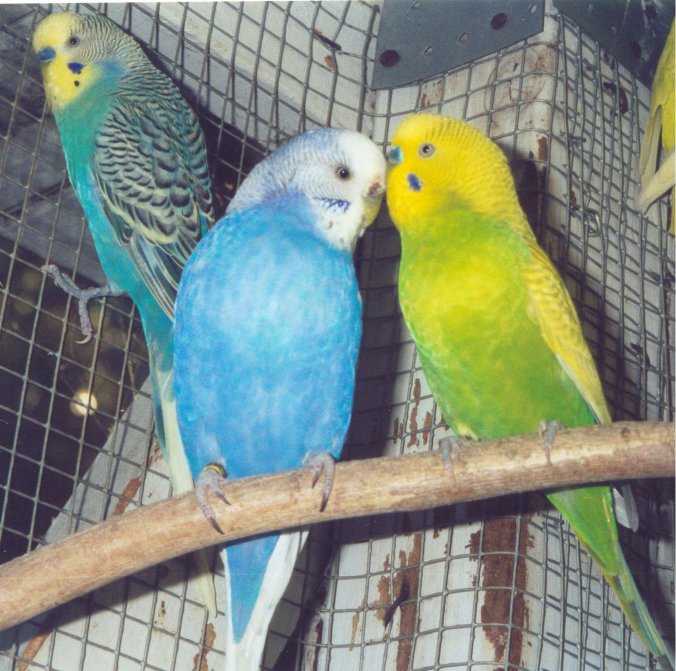
 budgies06Budgies come in a variety of colors.

Genus/Common Name Melopsittacus
Includes Budgie.
Size Small.
Talking Ability Very good.
Lifespan 5-15
Noise Constant chattering. Usually not offensive.
Dimorphic Yes.
Comments See species profile for more information. Great beginner pets, but they usually do not come tame.


tovi1


Genus/Common Name Cyanoramphus
Includes Kakarikis
Size Small.
Talking Ability Good.
Lifespan 10-?
Noise Pleasant.
Dimorphic Yes, but it takes experience.
Comments See species profile for more information. Kakarikis are high energy pets that require a lot of space and supervision. They rarely sit still for long and make very entertaining pets.

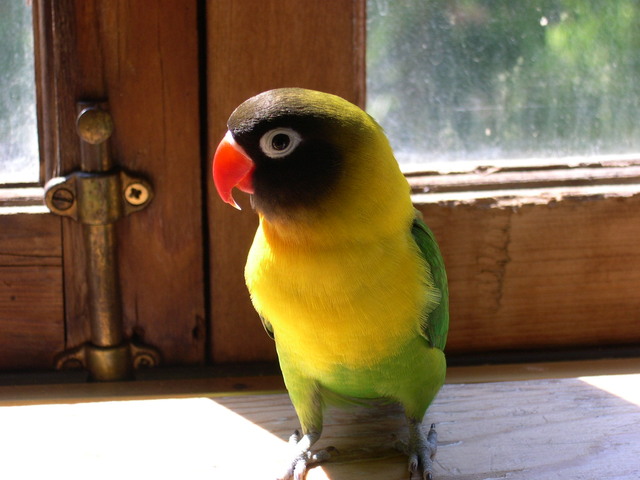
lovebird-1-1379868-640x480

Genus/Common Name Agapornis
Includes Lovebirds.
Size Small.
Talking Ability Limited.
Lifespan 10-20
Noise Like budgie only higher pitched.
Dimorphic Some.
Comments Make feisty and curious handfed pets.

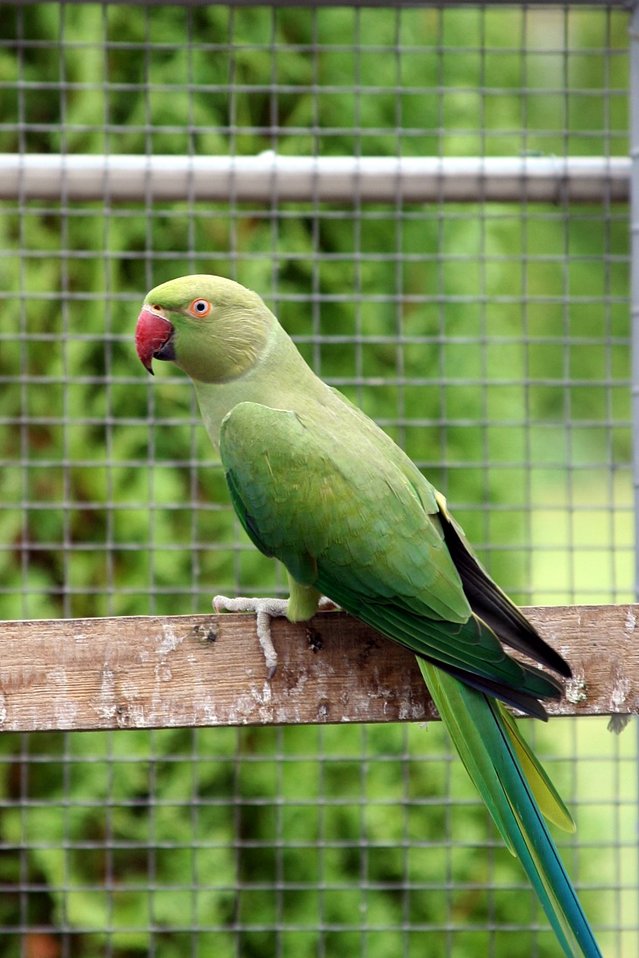
colorful-parrot-1381014-639x957

Genus/Common Name Psittacula
Includes Indian ringneck, African ringneck, Alexandrine, plum-head, blossom-head, Derbyan, Moustached.
Size Medium.
Talking Ability Excellent.
Lifespan 20-30
Noise Loud.
Dimorphic Yes.
Comments See species profile for more information. This genus is unfairly labeled “standoffish.” Ringnecks make excellent pets if well socialized. They are highly intelligent, curious and playful. They do tend to be strong willed and require a more experienced or assertive owner.


tovi7

Genus/Common Name Poicephalus
Includes Senegal, meyers, cape, jardine’s, brown-head.
Size Medium.
Talking Ability Moderate.
Lifespan 30-40
Noise Quiet.
Dimorphic No.
Comments Good apartment birds. Senegals are the most popular.


parrots-1380029-640x480


Genus/Common Name Ara
Includes Macaws (extinct/endangered ones in other genus).
Size Medium to large.
Talking Ability Moderate.
Lifespan 80-100
Noise Loud.
Dimorphic No.
Comments Not as popular as once were, perhaps due to size, expense and noise level. They are the larger relatives of conures. Intelligent and playful.


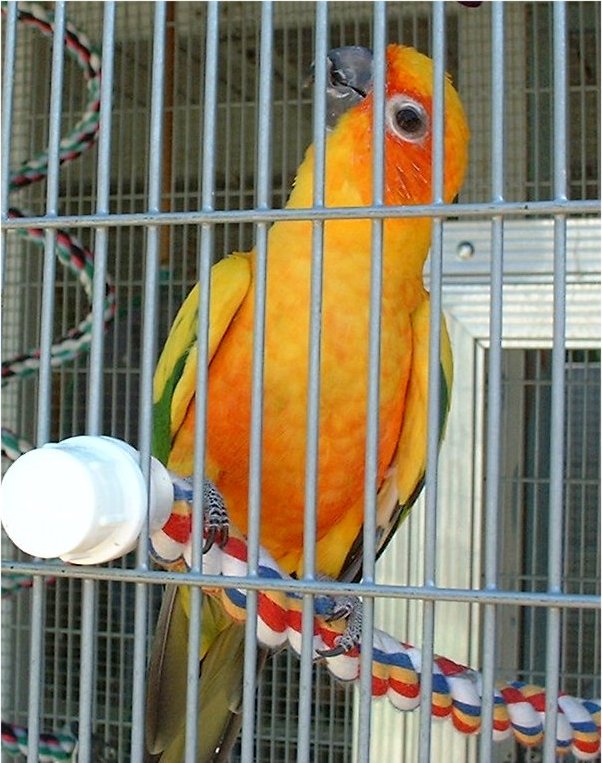
jayjay3Sun conures are very popular due to their color.

Genus/Common Name Aratinga.
Includes Most conures. Nanday in another genus but the profile still applies.
Size Medium.
Talking Ability Limited.
Lifespan 30
Noise Loud.
Dimorphic No.
Comments Very loud for size. Playful, curious pets. Very outgoing and fun-loving. Tend to become one-person birds if you let them.


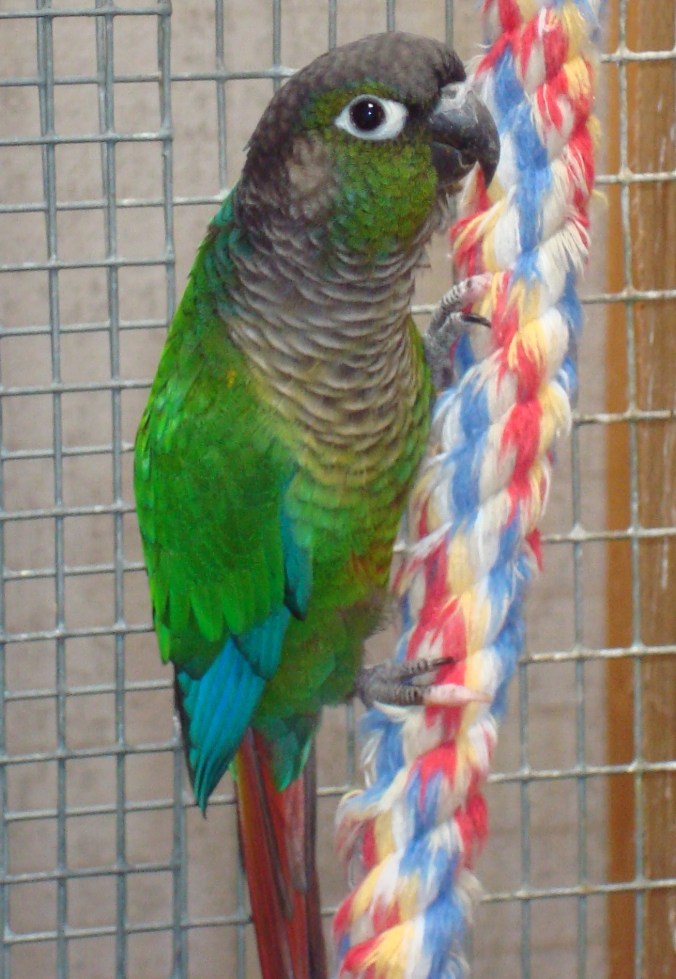
gc conureGreencheek conure

Genus/Common Name Pyrrhura
Includes Green-cheek, maroon-belly, pearl, paint and most other small conures.
Size Small.
Talking Ability Limited.
Lifespan 30
Noise Usually quiet.
Dimorphic No.
Comments Good for someone who likes conures but hates noise. These guys are smaller and generally much quieter.


 parrot-5-1250337-639x852


Genus/Common Name Brotogeris
Includes White-wing, canary-wing, grey-cheek, and other “pocket parakeets.”
Size Small.
Talking Ability Moderate.
Lifespan 30
Noise Loud.
Dimorphic No.
Comments Used to be available in large numbers. Very limited supply since importation stopped and these birds are difficult to breed. Known to be outstanding pets. Most of these birds should probably be in breeding programs though.


exotic-parrot-singing-1354249-639x425

Genus/Common Name Poinites
Includes Caique
Size Medium.
Talking Ability ?
Lifespan ?
Noise ?
Dimorphic No.
Comments South American species. Curious and feisty.


parrotlet-1366819-639x553

Genus/Common Name Parrotlet
Includes Parrotlet
Size Tiny to small.
Talking Ability ?
Lifespan ?
Noise ?
Dimorphic I think some species are.
Comments These guys are known as “mini amazons.” They have a large attitude for such small birds. They cannot be bred in colonies.


south-american-parrots-1362496-640x480

Genus/Common Name Amazona
Includes Amazons
Size Medium.
Talking Ability Excellent.
Lifespan 50-80
Noise Loud.
Dimorphic No.
Comments Outgoing and boisterous. Some species more mellow (mealy, lilac-crown, orange-wing). Can be very aggressive during breeding displays. Get hyper easily. Some, like double yellow heads and yellow napes, love opera and will make up their own songs.


pionus4

Genus/Common Name Pionus
Includes Pionus
Size Medium.
Talking Ability Moderate.
Lifespan 50-80
Noise Quiet.
Dimorphic No.
Comments Good apartment birds. Appealing to people who like South Americans but dislike noise.


african grey1

Genus/Common Name Psittacus
Includes African grey
Size Medium.
Talking Ability Excellent.
Lifespan 50-80
Noise Quiet but like to pick up household noises to repeat constantly (much to the annoyance of some owners).
Dimorphic No.
Comments Highly intelligent and excellent mimics, but shy and sensitive. Can be badly affected by change if normally kept on a strict schedule. Plucking very common if stressed.

© 1997-2016 by Karen Trinkaus. May not be reprinted or used in any way without the author’s permission.
Colony Breeding

aviary2

Set Up
Colony breeding is something that is best done in an aviary. Nestboxes should obviously be provided for each pair but you should also throw in 2-3 extra so the birds can have their pick. Unused boxes can always be removed once everyone has settled in. Several feed stations and water dishes should be placed in various locations to avoid fights. Never place one nestbox or perch higher than the others because everyone will want to use it. Nestboxes should all be at the same height. Perches can vary in height as long as there are more than one “highest perch.”

budgie07

Feed
Keep in mind that you’ll be feeding a single diet. Birds that require special foods should not be kept in a colony. Likewise, if you have some picky birds or seed junkies you’ll have to feed seed. You can try offering pellets in hopes that your junkies will learn to eat them from your other birds. However, even pellet eaters will usually eat seed instead of pellets if they are provided. The good news is that everyone learns to eat soft foods very quickly.

Non-Breeding Colony
Follow the instructions for picking mixed flight species. Some birds are only aggressive during breeding and many different species of some size variation can be kept safely when there are no nestboxes provided. Retailers often keep birds for sale in such a set up. These work well because no one is interested in breeding and since birds are coming and going all the time no one has time to establish territory.

bird-cage-1393407-1279x852


Same Species Colonies
Some species, like budgies, actually thrive in colony situations. Keep in mind that with this type of colony you’ll get a lot of cheating between pairs. If you want strict control of your bloodlines this set up is not for you.

Mixed Colonies
This is how I breed. Most of the Australian keets like budgies, cockatiels and Neophema can coexist fine with similar species. Very closely-related species shouldn’t be kept together to prevent hybridization. The trick to a mixed colony is keeping birds of similar size and temperament. You want calm, small birds that aren’t likely to pick fights with their neighbors.

yf_kaks 008

Semi-Colony Species
Some birds can be bred in same species colonies only if the cage is very large. These birds should always be watched very closely and pulled out at the first sign of real aggression. Birds that fall into this category are Brotogeris, some lovebirds (Fischers usually do okay in colonies), and some conures (Patagonian).

Aggressive Species
Most parrots can’t be bred in colonies. These birds may be fine in a non-breeding colony but will become very aggressive towards any other birds when nesting. They may nip off toes (make sure there they can’t get to the birds in the cage next door), maim or kill. Aussie keets that should be avoided are red-rumps and rosellas. Always look at how species breed in the wild to best determine how to breed them in captivity.

© 1997-2016 by Karen Trinkaus. May not be reprinted or used in any way without the author’s permission.

Shopping for a Bird


lovebird-1-1365617-639x511What kind of bird do you want?

The first thing you need to do is decide on the right species. This requires a bit of research and involves you knowing exactly what you want. I have a brief species guide here.

Size
How big do you want your bird? Size plays a large role in other bird characteristics. It can affect noise, the amount you’ll have to spend on a cage and toys, the lifespan and the price. The larger the bird, the more expensive it will be to set up and maintain.

Lifespan
Larger birds generally live longer. Budgies can live up to 15 but often die much earlier due to malnutrition or tumors. Cockatiels and other big smaller birds like conures and Senegals can live from 20-30. Most of the parrots like amazons and African greys can live 50-80. Macaws have been known to make it to 100. A larger bird means a much longer commitment.

Price
In general, the bigger the bird the larger the price tag. Species that are less common or more difficult to breed will also cost more. Galahs and Goffins are both similarly-sized cockatoos but Galahs are far more expensive. Newly-developed colors can also cost quite a bit.

Noise
Many parrots scream. If you live in an apartment or can’t handle a loud animal then you need to factor this into your decision. Volume isn’t the only thing to take into account though- if possible, research what your preferred species sound like. Sometimes a particular noise will be bothersome to you but not others.

exotic-parrot-singing-1354249-639x425


Character
Each species varies in character and it’s very important to pick one that you can get along with. Some people like cuddlers while others prefer boisterous birds that are more hands-off.

Availability
It’s no use picking a species that is very rare and belongs in a breeding program (unless that’s why you’re searching for it). Some species are available year-round while others will have babies at certain times of the year. If you’re adopting you may have a harder time finding your preferred species. Certain states in the U.S. breed more birds and will have a better selection.

Speech
This is the last quality in the world to be looking for in a bird. Anyone who picks a species solely on it’s ability to talk is making a grave mistake. Don’t get me wrong, it’s a nice thing to have, but it’s only the icing on the cake.

Once you’ve decided on a species you still need to buy it. The following are things you need to look for while you’re actually out shopping.

Movement
Birds that are moving around in the cage and making lots of noise are often healthy, happy birds.

Appearance
The bird should look healthy. Colors should be bright. Feathers, eyes, vent, nostrils and everything else should be clean.

parrot-1572979-639x961

This bird is sick. It’s slouching and it’s feathers are a bit ruffled and unkempt.


macaw-1246525-640x480

These birds appear healthy: clear eyes, neat feathers, ACTIVE posture.

Other Birds in the Cage
Check the other birds in the cage. Do they look bad? If so you’d best move along. Maybe they are ill and the one bird you like just isn’t displaying any symptoms yet.

Age
Recently I’ve seen more people pushing others to adopt birds rather than buy a baby. As a breeder I’m obviously biased, but I’ve taken in my share of older birds and I really don’t recommend it to novice owners. You’ll have no idea what kind of behavior problems a used bird may have, nor the experience to combat said problems. Training will be much more difficult. Underlying health problems are also a concern. You just don’t know what you’re getting. If you are new to birds I highly recommend getting a baby from a reputable source. You’ll be starting with a clean slate.

Price
In general don’t buy from pet stores. Their price will be double that of anything offered by a private breeder. Shop around to get an idea of what the usual price is.

Source
Again, avoid pet stores, especially if they are a larger chain like Petco. They have no business selling live animals and often buy animals from large scale wholesalers. The only exception would be a store that specializes in birds and has a good relationship with several reputable breeders.

The seller can tell you a lot about the bird being offered. You want to buy from someone who is knowledgeable, helpful, knows the bird’s history, and is reputable. If the seller is junk most likely the birds will be too.

© 1997-2016 by Karen Trinkaus. May not be reprinted or used in any way without the author’s permission.

The Pros and Cons of Owning Parrots

Pro: Intelligence

Psittacines, along with Corvids, are among the most intelligent birds. It is often estimated that larger parrots can understand concepts on par with human preschoolers.

Con: Birds are messy

Birds are some of the messiest pets you can get. Expect to find seed sprouting in your carpet or sink. Your carpet may feel crunchy. Forget seed guards- nothing will ever stop your birds from flinging all they can as far as they can. I’ve had budgies take baths in their seed.

The best defense against mess indoors: Buy plastic carpet protectors and put them beneath and all around your cages. If you’re handy you can attach plexiglass sheets to the back and sides of your cages, which should reduce the spray. Clear shower curtains hung behind your cages will save your walls from being splattered with fruit.

Pro: Many species can Talk

Parrots and a few other birds have the amazing ability to mimic human speech (some so well that there are cases where a person was invited into the house mistakenly by the family bird) . Birds can often understand what they are saying, though it depends on how they were taught. Avian intelligence research with an African grey named Alex found that parrots can correctly count to six, identify shape, color, size, and substance.

Many birds have even been known to make up words for ones they don’t like or can’t pronounce. One grey, Arrow, named its owner “Joba.”Alex made up the word “banerry” when introduced to apples, because they looked like cherries but tasted a bit like banana.

In the wild birds use sound to communicate with each other. This is why they pick it up so easily in captivity. They naturally want to learn the language of their flock. This is also why they can understand it so well- better than dogs.

Con: Not all Birds Talk

Even if a species is known for its talking ability, there is no guarantee it will ever learn to talk and it is unreasonable to buy a bird solely for speech. In fact, many birds prefer to whistle or imitate sounds around the house like the microwave or doorbell. These sounds are much closer to natural bird calls and are picked up very easily. This also means you could have a bird on your hands that beeps, rings, coughs, and creaks all day long.

Pro: Variety of Size and Color

Parrots come in a wide variety of sizes and colors. Do your research to find out which species would be most compatible for you.

Con: Aesthetics Mean Little if the Species is Incompatible

The first time I ever saw a rainbow lorikeet I was amazed. What a beautiful bird! And so playful! Then I found out what lorikeets ate.

Regardless of what you find most attractive, always keep in mind that not every bird is going to work with your living situation. Live in an apartment? Then you probably don’t want an amazon. Birds are not curtains or plants. They are living, social creatures and their needs should be met.

ringneck_chick10

Pro: Birds are Very Social

Birds make great pets! They are playful, cuddly and sweet. Unlike dogs, they don’t have to be taken for walks or played with. Most are content just hanging out on or with their favorite person. Good owners like to let their birds out as often as possible. Many of us watch TV, read and work on the computer with our birds.

Con: Birds can be Demanding

Parrots are very social, as they live in flocks in the wild. Unlike a dog, which is generally allowed to follow you around the house, birds are often confined to one area. This can lead to panicked screaming if you leave the room. They want to know where you are! If you can’t spend a decent amount of time with your pet every day I recommend getting a second bird. It doesn’t even have to be the same species- just someone they can talk to and hang out with when you’re not around. A bird left alone without much to do is going to develop behavior problems.

Pro: Birds Live a Long Time

My sister used to subscribe to Cat Fancy, while I got Bird Talk. One month both came in the mail the same day. Cat Fancy had an article on coping with the loss of your cat; Bird Talk had one on making sure your parrot is well provided for after your death. Even many small birds could easily outlive a cat or dog, whose average lifespan is only 15 years. Budgies (parakeets) can live about that long. With good care cockatiels usually make it to their twenties, small parrots can live to their 30’s or 40’s, and large parrots can live to be over 80! With good care your pet bird will be with you a long time.

Con: Birds Live a Long Time

What will happen to your bird when you go to college? Move? Enter a serious relationship? Have children? Birds live long enough that they will be there to see you through many of life’s transitions. Buying a bird, especially a large one, is a lifetime commitment. It’s like adopting a child. You may even have to set up a trust fund for your bird. Birds often end up in uncaring hands of family members once their human has passed. You need to make sure you have a plan in place to care for your pet if something happens.

© 1997-2016 by Karen Trinkaus. May not be reprinted or used in any way without the author’s permission.

Multiple Pet Birds Sharing Spaces

colourful-bird-2-1250379-639x830

This is what consent looks like.

I been seeing a discomforting trend lately on Facebook- a lot of inexperienced people are allowing their birds to play together with minimal supervision. While this may seem rather innocuous, it can lead to brutal injuries when the birds clash.

One post, since deleted, was a long rant about the “hidden costs” of owning birds. The owner complained about spending well over $3000 on veterinary bills for a single bird. The aggressive conure had had wings broken on two separate occasions during altercations with other birds. After X-rays and surgery, the bird had amazingly recovered the ability to fly. The owner decided to keep it in its cage, but still allowed other birds access to climb on it. This conure was known to be very territorial of its cage. Not surprisingly, another bird ended up with a severely lacerated/crushed ankle that would likely need to be amputated.

Another man posted a video of his amazon propositioning his Goffin cockatoo, with the caption “please explain.” It was very clear from the body language that the Goffin was not happy. It was about as far removed as possible without flying to a new location. It was at a lower perch position, making it even more defensive. It was likely that the amazon kept encroaching into the Goffin’s personal space until it had ended up where it was- with no place to go. Any time the amazon got too close the Goffin would threateningly open its beak. When the amazon’s posture returned to normal the Goffin relaxed slightly. This went back and forth for a while.

The above interaction didn’t lead to a fight, but it certainly could have. The owner also reported that the amazon had begun getting aggressive towards anyone who tried to handle the object of his affection. Thankfully, the owner had the good sense to separate the birds after he found out what the body language meant.

Most people are reasonably familiar with dogs and cats. Even when they anthropomorphize their pets they generally don’t make mistakes that are quite as grievous. Dogs have cohabitated with humans for so long that the ability to read humans is built into their domestication. One study demonstrated that even puppies with no prior training will pay attention to where a human is pointing. Human children don’t even pick up that skill until around the same time they begin to walk!

Parrots, on the other hand, are not domesticated and have comparatively weird body language. It makes their behavior a lot harder to interpret without practical experience. Allowing pet parrots to share the same space when you don’t have a comfortable working knowledge of bird body language is a recipe for disaster.

© 1997-2016 by Karen Trinkaus. May not be reprinted or used in any way without the author’s permission.